How Nursery Automation Can Improve Labour Efficiency Without Replacing Your Entire Workflow
Nurseries do not always have to automate everything to improve productivity. The biggest wins in many operations come from identifying repetitive tasks that consume labour and finding ways to automate those that fit naturally.
Common pressure points include:
- Repetitive handling and movement of pots or trays.
- Manual seeding and transplanting.
- Labour tied up between production stages.
- Inconsistent production speeds between operators.
- Difficulty increasing output without increasing labour hours.
Nursery automation in Australia can offer a pathway for Australian growers to improve workflow efficiencies while retaining practical human supervision where it still adds value. KW Automation helps growers consider individual machines and connected processes based on how their nursery actually operates.
Where Can Automation Reduce Labour in a Nursery?
Automation can reduce labour most effectively in repetitive, predictable tasks, rather than trying to remove people from every part of production.
A nursery workflow can contain several opportunities:
|
Production stage |
Typical manual task |
Where automation may help |
|---|---|---|
|
Media preparation |
Moving and preparing growing media |
Mixing and material handling equipment |
|
Pot or tray preparation |
Positioning containers |
Dispensing and feeding equipment |
|
Seeding |
Repetitive seed placement |
Automated seeding equipment |
|
Transplanting |
Moving seedlings into containers |
Transplanting systems |
|
Filling |
Loading growing media |
Tray and pot filling equipment |
|
Movement |
Carrying trays or pots |
Conveyors and accumulation systems |
|
Stacking |
Organising finished trays |
Automated stacking equipment |
The important point is that automation does not have to start with the most expensive or technically complex part of the nursery.
Start with the task
Before looking at equipment, identify where workers spend the most time doing the same movement repeatedly.
Look for tasks that are:
- Repetitive.
- Physically demanding.
- Easy to standardise.
- Required throughout the production day.
- Creating delays for other processes.
These are often better automation candidates than tasks requiring frequent judgement or changing inputs.
Improve Labour Efficiency In Your Nursery
Which Nursery Tasks Are Best Suited to Automation?
The strongest candidates are usually tasks where the input, movement and output are reasonably predictable.
Seeding
Seeding can involve repeated tray handling, seed placement and machine feeding. Where production volumes justify it, nursery seeding equipment in Australia can help move this repetitive stage into a more controlled process.
A seeder machine may be particularly useful when the nursery works with consistent tray formats and regularly produces similar crops.
The practical consideration is not simply how quickly a machine can seed. The surrounding workflow needs to supply empty trays, seed and growing media at a suitable rate.
Transplanting
Transplanting can also involve significant repetitive handling.
A nursery may use workers to repeatedly:
- Pick up seedlings.
- Position them.
- Move containers.
- Check placement.
- Continue the cycle.
Where the production process is sufficiently consistent, nursery transplanting equipment in Australia can reduce some of this repetitive handling.
Pot and tray movement
Not every labour problem comes from the main production operation. Workers can also spend substantial time moving trays, pots and containers between machines.
This is where a nursery conveyor system in Australia can become useful.
Conveyors can connect individual stages so operators do not have to manually transport material between every machine.
Does Automation Mean Replacing Your Existing Workflow?
No. In many nurseries, the more practical approach is partial automation.
Instead of replacing an entire production line, growers can automate one bottleneck and then assess what happens to the rest of the workflow.
For example:
Manual preparation → Automated seeding → Manual inspection → Conveyor movement
This can be more practical than attempting to automate every stage simultaneously.
A phased approach can limit disruption. A staged automation plan may involve:
- Identifying a labour intensive job.
- Automate that procedure.
- Measuring the impact on the neighbouring workflow.
- Addressing the next bottleneck.
- Connecting stages as production requirements increase.
This approach also allows operators to become familiar with new equipment before additional automation is introduced.
How Should You Identify Your Biggest Labour Bottleneck?
Look at where people are consistently waiting, walking, lifting, feeding or repeating the same task.
A simple workflow review can ask:
|
Question |
What it reveals |
|---|---|
|
Where are workers spending the most time? |
Major labour-consuming activities |
|
Where do products regularly queue? |
Potential production bottlenecks |
|
Which task is repeated throughout the day? |
Strong automation candidate |
|
Where is manual handling highest? |
Material movement opportunity |
|
Which stage limits the next machine? |
Capacity constraint |
|
What changes between batches? |
Automation complexity |
|
Where could one machine support several stages? |
Integration opportunity |
This is more useful than choosing equipment based purely on advertised capacity.
A machine that is faster than the rest of the production line does not automatically improve the whole nursery. If the next stage cannot keep up, the additional capacity simply creates a queue.
Can Automation Improve Labour Efficiency Without Increasing Complexity?
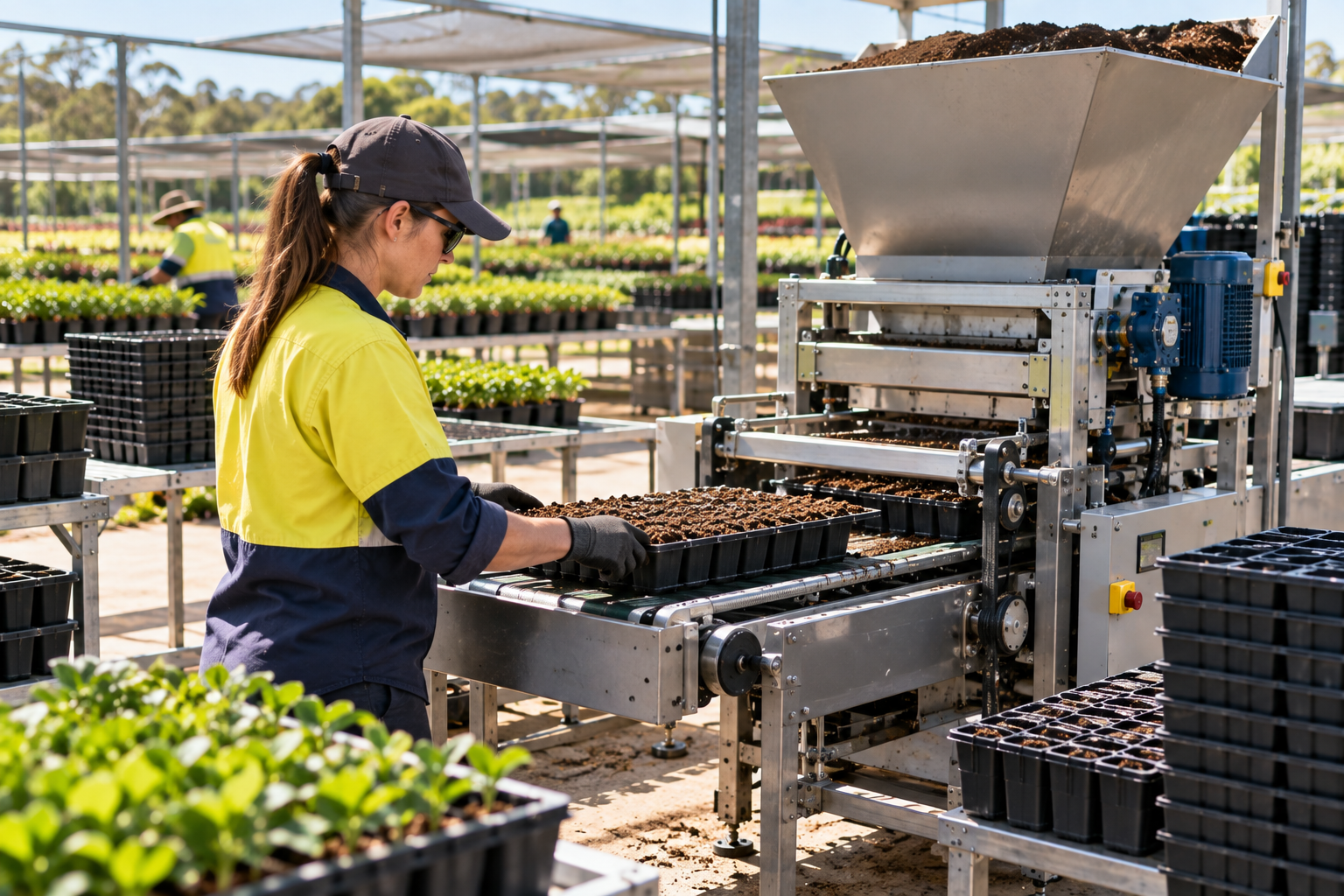
Yes, but only when the equipment is matched to the nursery’s existing processes.
A common mistake is to view automation as a collection of individual machines. In practice, the interaction between machines can be just as important.
Consider a workflow involving:
Seeding → transplanting → conveying → stacking
If one stage operates considerably faster than another, the result can be:
- Tray accumulation.
- Operator waiting.
- Manual intervention.
- Unused machine capacity.
- Additional handling.
This is why workflow planning should come before equipment selection.
Look at the whole production cycle
When assessing automation, consider:
Input → processing → movement → inspection → output
Each stage needs enough capacity to support the next one.
This can help identify whether the right investment is a new machine, a conveyor, an accumulation point or simply a change in workflow.
Which Supporting Equipment Can Make Automation More Effective?
Automation often works best when the supporting handling stages are considered alongside the primary machine.
For example, nursery dispensing equipment can help with repetitive container or tray feeding, while conveyors can move products between production stages.
Similarly, a nursery tray stacking machine can help organise completed trays after processing rather than returning that repetitive task to workers.
These supporting systems can matter because labour savings are not always found in the main production operation.
Sometimes the bigger opportunity is the work happening before and after the machine.
What Should You Automate First?
The first automation project should normally target a task that is repetitive, measurable and causes a genuine operational constraint.
A useful priority framework is:
1. Frequency
How often does the task occur?
A repetitive task performed throughout every production day generally deserves more attention than an occasional activity.
2. Labour involvement
How many people are required?
Take into account the number of workers and the time they spend on the activity.
3. Bottleneck impact
Is some other part of production restricted by the task?
If the task is already faster than everything around it, automating it may have little overall value.
4. Standardisation
Can the task be performed consistently?
Automation is generally easier when tray sizes, containers, materials and production sequences are reasonably predictable.
5. Future requirements
Will the same bottleneck remain as production grows?
Equipment should be considered against expected production requirements rather than only today’s workload.
What Are the Signs Your Nursery Is Ready for More Automation?
Several operational signals can indicate that automation deserves closer consideration.
- Workers spend large amounts of time on repetitive handling.
- Production increases require additional labour.
- One stage repeatedly holds up another.
- Output varies because production depends heavily on operator speed.
- Manual movement occurs between several machines.
- The nursery has predictable tray, pot or crop formats.
- Production is expected to increase over the coming seasons.
The presence of one sign does not automatically mean automation is required. The stronger signal is when several occur together and begin affecting production capacity or labour planning.
How Can You Build an Automation Plan Without Overhauling Everything?
Start with the current workflow and map every major movement.
For example:
Media preparation → Filling → Seeding → Transplanting → Movement → Stacking
Then identify:
- Where workers handle materials.
- Where products stop or accumulate.
- Where production speed changes.
- Which tasks are repeated most often.
- Which stage currently limits output.
From there, automation can be introduced progressively. This approach keeps the focus on solving operational problems, rather than on buying machines just because automation exists.
When Does Partial Automation Make More Sense?
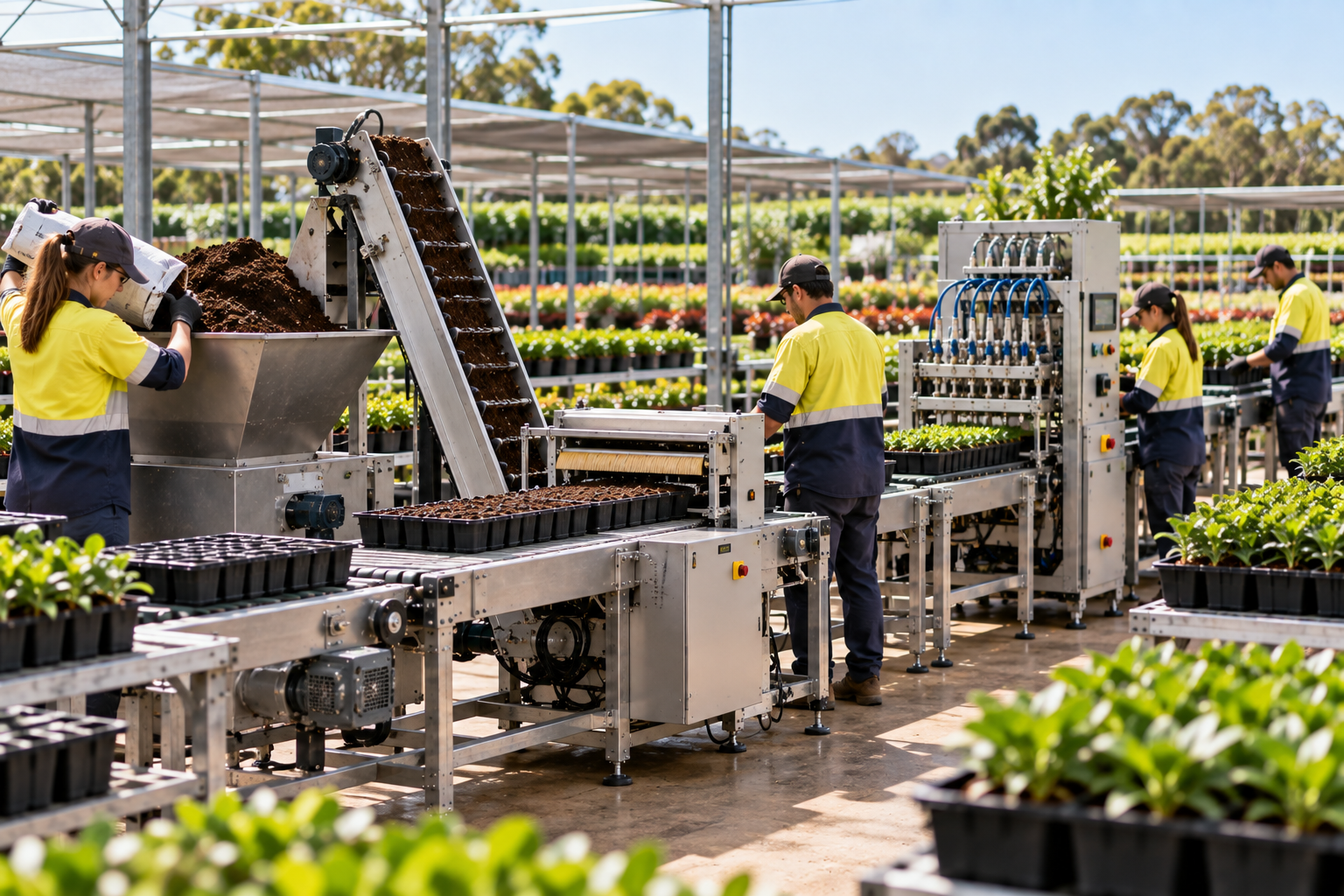
Partial automation can make sense if a nursery has a clear bottleneck but doesn’t yet need a fully automated production line.
|
Nursery situation |
Potential approach |
|---|---|
|
One repetitive task consumes significant labour |
Automate that task first. |
|
Several machines require manual transfer |
Investigate conveyor integration. |
|
Production is growing gradually |
Build automation in stages. |
|
Tray and container formats are consistent |
Consider dedicated automated equipment. |
|
Production varies significantly |
Prioritise flexible equipment and workflow design. |
|
Existing machinery works well |
Add automation around the current process. |
This allows growers to focus investment where it can have the greatest practical effect.
Scale Nursery Production With Smarter Automation
Conclusion
The most useful automation plan is one based on the nursery’s actual workflow, production requirements and labour constraints.
KW Automation can help growers assess where equipment may fit within existing operations, from seeding and transplanting through to conveying, dispensing and tray handling.
For nurseries considering nursery automation, the objective should not be to automate everything. It should be to identify the repetitive processes where automation can create a more efficient, consistent and scalable workflow.
Ready to assess your nursery workflow? Speak with KW Automation about your current production process and the areas where automation may make the biggest practical difference.
FAQs
Is automation suitable for smaller nurseries?
It can be, particularly when a smaller operation has one clearly defined repetitive task consuming significant labour. Smaller nurseries do not necessarily need a complete automated line. A single machine or handling system may be more appropriate when it addresses a specific production constraint.
How long does it take to introduce nursery automation?
The timeframe is dependent on equipment, site preparation, integration requirements and installation complexity. A stand-alone machine can be a different process than a connected production line. Minimising operational disruption can also be achieved by planning installation around production schedules.
Can existing nursery machinery be retained?
Yes. Automation does not necessarily imply the removal of existing equipment. Sometimes new equipment can be added around machinery that is already performing effectively. The question is whether the machines can work together without creating new handling problems or capacity bottlenecks.
What information should I provide before discussing automation?
Useful information include production volumes, container and tray formats, current labour requirements, existing machinery, workflow layout and the main bottlenecks. Photos or a simple flow diagram can also help an equipment supplier see where automation might fit in.