Soil Mixer Buying Guide for Australian Nurseries
Preparing consistent growing media is an important part of nursery production, but mixing soil or growing media manually can become difficult as production increases. The right mixer needs to suit the material, batch size and workflow rather than simply offering the largest capacity.
For Australian nurseries, the decision usually comes down to:
- How much material needs to be mixed.
- How consistently the mix needs to be prepared.
- What materials are being combined.
- How the mixer will connect with the rest of the workflow.
- How much operator involvement is practical.
KW Automation supplies nursery machinery designed around practical production requirements, helping growers consider equipment as part of the wider nursery workflow.
Focus: Choosing soil mixer machine for nurseries for consistent growing media preparation.
Key Considerations: Mixing capacity, batch size, material compatibility, mixing consistency, loading method, cleaning, maintenance and available workspace.
Equipment Approach: Select a machine mixer that matches your nursery’s production volume and existing soil handling workflow.
Professional Tip: A proper soil mixer machine Australia setup can assist in making media preparation more uniform and lessen repetitive manual handling.
Result: A better prepared growing media, a smoother flow of production and equipment that fits the daily needs of the nursery.
What Should You Consider When Choosing a Soil Mixer?
The best soil mixer depends on your material, batch requirements, production volume and downstream equipment. A mixer that works well for one nursery may not suit another simply because its production process is different.
Before choosing equipment, assess:
|
Factor |
What to consider |
|---|---|
|
Material |
Identify the soil, growing media and amendments being mixed. |
|
Batch size |
Match mixer capacity to normal production requirements. |
|
Mixing consistency |
Consider how repeatable the finished mix needs to be. |
|
Production volume |
ook at daily and weekly requirements rather than occasional peaks. |
|
Loading |
Consider how materials will be introduced into the mixer. |
|
Discharge |
Check how easily the finished material can move to the next stage. |
|
Space |
Allow room for operation, loading, cleaning and maintenance. |
|
Workflow |
Consider how the mixer connects with filling or potting processes. |
The objective is not simply to find a machine with a larger capacity. It is to find equipment that fits the actual production cycle.
Choose The Right Soil Mixer For Your Nursery
When Does a Nursery Need a Soil Mixer?
A dedicated mixer becomes more relevant when manual preparation starts creating inconsistency, labour pressure or workflow delays.
Typical signs include:
Growing production volumes
As the number of containers or batches increases, manually preparing growing media can take more time and operator attention.
Repeated media recipes
If a nursery regularly prepares the same or similar growing-media formulations, a dedicated mixing process can make the workflow more repeatable.
Labour-intensive preparation
Manual loading and mixing can tie workers to repetitive preparation tasks. Mechanising this stage can allow labour to be used elsewhere in the nursery.
Bottlenecks before filling
The mixer should be considered alongside what happens after mixing. If prepared media cannot move efficiently into the next stage, increasing mixer capacity alone may not solve the bottleneck.
This is an important planning point. Mixing capacity should be assessed against the capacity of the equipment downstream. A fast mixer feeding a slower filling operation can simply move the bottleneck rather than remove it.
How Does a Soil Mixer Fit Into a Nursery Workflow?
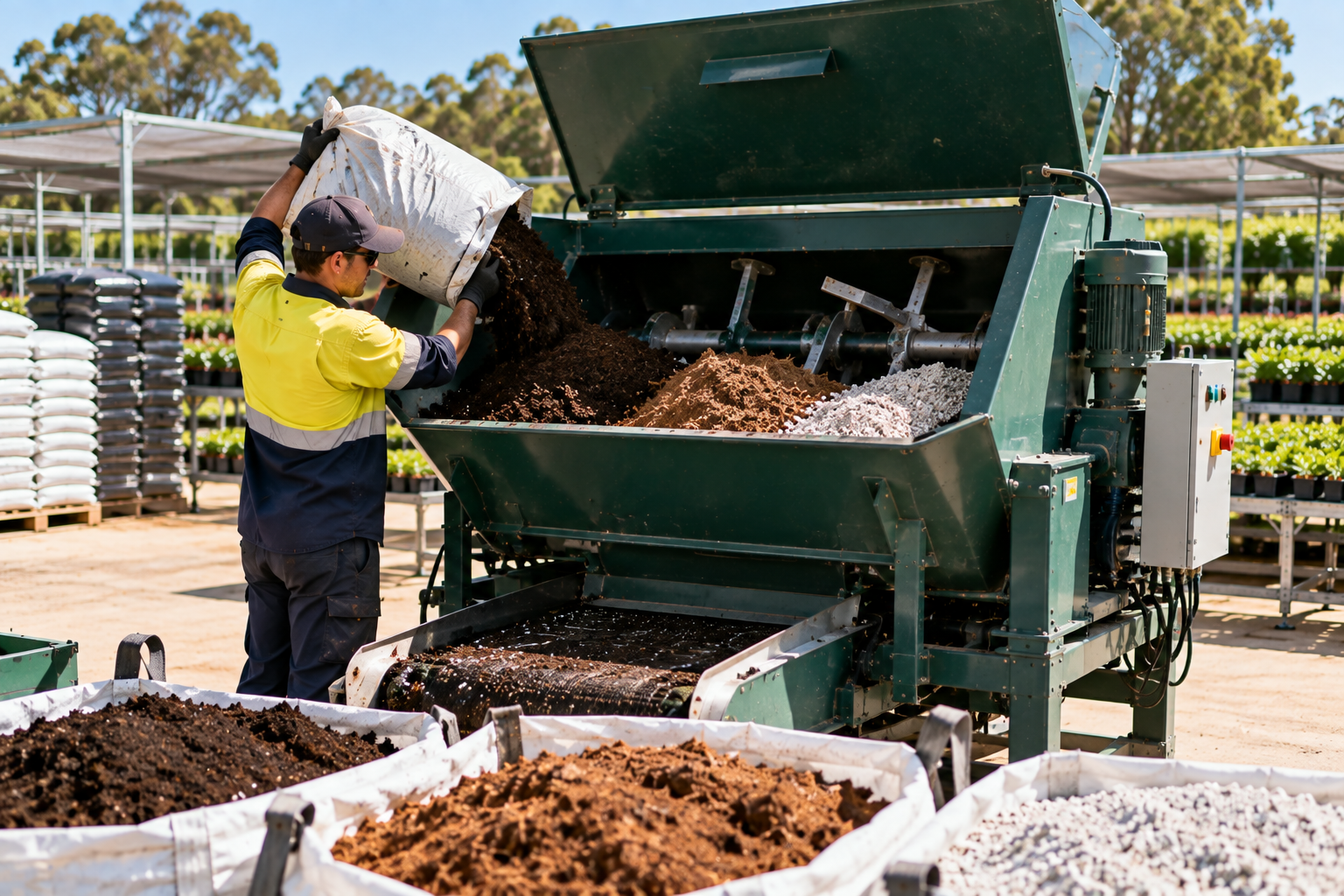
A soil mixer is most useful when it forms part of a connected material-handling process.
A typical workflow may look like:
Material preparation → Mixing → Discharge → Transfer → Filling or potting
This is where nursery soil systems in Australia can be relevant. Instead of thinking of a mixer as a stand-alone machine, growers can think about how soil preparation relates to other nursery processes.
For example, a nursery may need to consider:
- Where raw materials are stored.
- How materials reach the mixer.
- Where finished media is discharged.
- How prepared media reaches filling equipment.
- Whether temporary storage is required.
- How operators move between stages.
A machine can perform well technically but still create workflow problems if material has to be moved manually several times afterwards.
What Type of Soil Mixer Capacity Do You Need?
Capacity should be based on your normal production requirements, not just the maximum amount you could mix theoretically.
Consider the following:
Batch requirement x number of batches x operating schedule
Nurseries that are doing smaller batches may not require large equipment. Conversely, a high volume operation might need a mixer that can keep up with its filling or potting process.
|
Nursery requirement |
Planning method |
|---|---|
|
Occasional mixing |
Reconsider the practicality of current preparation methods. |
|
Small regular batches |
Size mixer capacity to meet production requirements for repeats. |
|
Stable commercial production |
Assess daily workflow against mixer capacity. |
|
High-volume manufacturing |
Look at the entire material handling chain. |
|
Planned expansion |
Meet future production needs without excess overcapacity. |
The key is to assess usable production capacity, not just the machine’s stated batch size.
What Materials Should You Consider Before Buying?
Different nurseries use different growing-media recipes, so the mixer should be selected around the materials it will actually handle.
Consider:
- Soil or growing media.
- Organic materials.
- Amendments.
- Fertiliser or nutrient additions.
- Moisture levels.
- Particle size.
- Required mixing consistency.
The physical characteristics of the material can influence how efficiently it mixes and how it moves through the wider system.
This is also why soil handling equipment nursery requirements should be considered alongside the mixer itself. Storage, loading and discharge can have just as much influence on workflow efficiency as the mixing stage.
Should Your Soil Mixer Connect With Other Nursery Equipment?
Yes, where practical. A soil mixer is often more useful when its output can feed efficiently into the next production stage.
For nurseries already using automated equipment, integration may be particularly important.
For example, prepared media may eventually move towards:
- Pot filling.
- Tray filling.
- Container preparation.
- Planting operations.
- Other automated nursery processes.
A mixer therefore should not be selected independently from the rest of the production line.
For operations using a commercial potting machine, the consistency and availability of prepared media can become an important part of keeping the potting process moving.
What Should You Check Before Purchasing?
Before requesting specifications or pricing, prepare a basic equipment brief.
Your pre-purchase checklist
- Typical batch size.
- Daily material requirement.
- Types of materials being mixed.
- Required mixing consistency.
- Available operating space.
- Loading method.
- Discharge location.
- Existing filling or potting equipment.
- Planned production growth.
- Cleaning and maintenance requirements.
This gives the equipment supplier useful information before recommending a configuration.
A good equipment decision starts with the production process, not the machine catalogue.
When Is Automation Worth Considering?
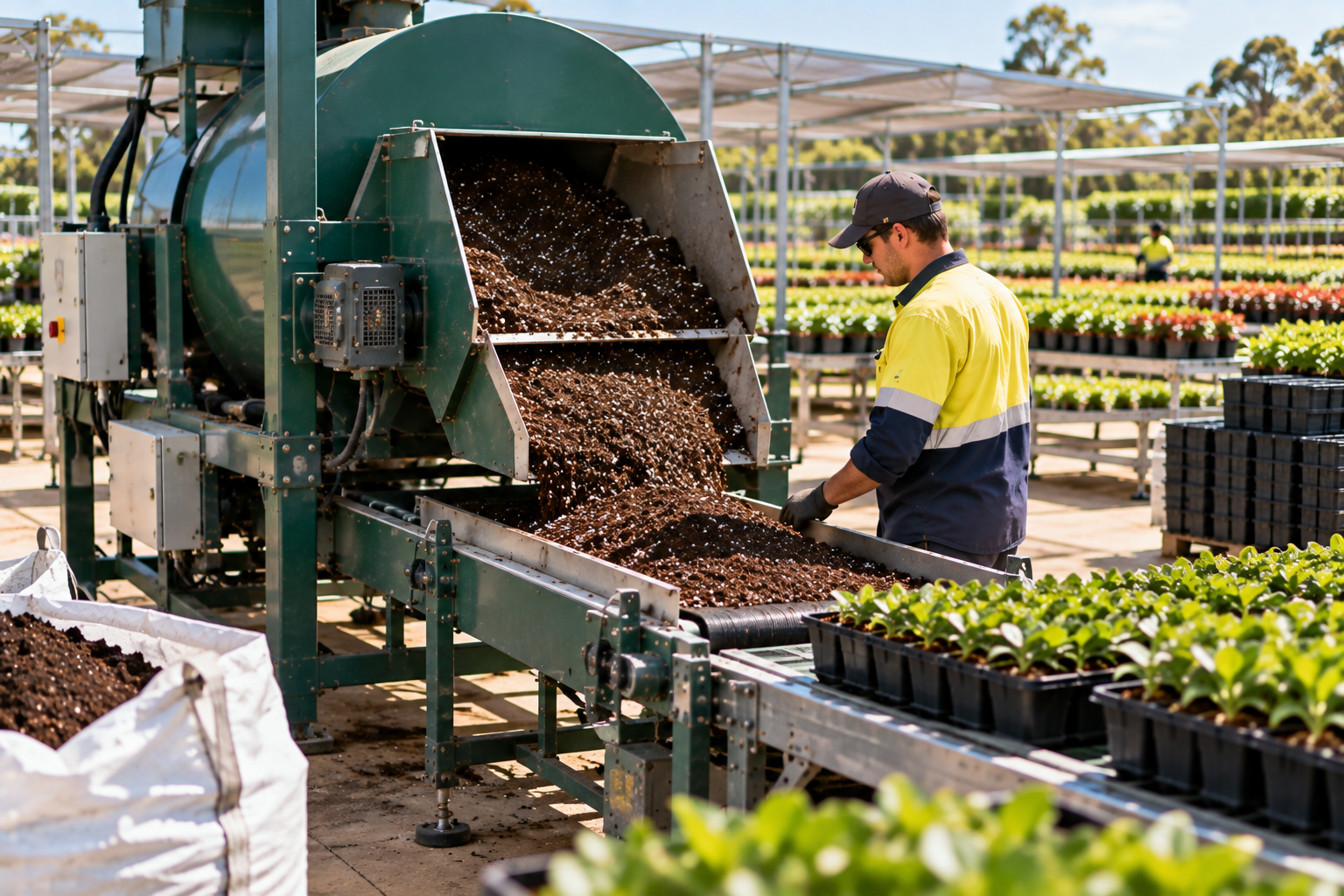
Automation becomes more relevant when material preparation is a recurring production task and manual handling starts limiting capacity or consistency.
However, automation does not automatically mean buying the largest available system.
For some nurseries, the priority may be:
- Reducing repetitive manual work.
- Improving material consistency.
- Connecting preparation with filling.
- Increasing repeatability.
- Preparing for production growth.
For others, the existing manual process may remain appropriate.
The right decision depends on the nursery’s production volume, available labour, growing-media requirements and wider equipment setup.
Plan Your Nursery Soil Handling Setup
Conclusion
A suitable soil mixer should fit the nursery’s materials, batch requirements and production workflow. Capacity, discharge, loading, consistency and integration all deserve attention before selecting equipment.
For Australian growers considering a soil mixer machine, KW Automation can help assess the equipment requirement in relation to the wider nursery process rather than treating soil preparation as an isolated task.
If you are planning to improve soil preparation or connect it with other nursery equipment, get in touch with KW Automation to discuss your requirements.
FAQ
How often should a nursery soil mixer be cleaned?
Frequency of cleaning will depend on the type of material being processed and the nursery operation schedule. Mixers should be cleaned and inspected according to the manufacturer’s recommendations, especially when changing media recipes or materials that may build up inside the mixer.
Can a soil mixer be used with different growing-media recipes?
Potentially, depending on the design of the machine and the materials used. If nurseries are using multiple recipes they should discuss the materials, batch sizes and desired mixing consistency with the equipment supplier before selecting a mixer.
How much space is needed for a nursery soil mixer?
The machine itself is only part of the space requirement. Allow room for loading, discharge, operator access, cleaning and maintenance. The surrounding material flow should also be considered so the mixer does not create a new handling bottleneck.